

 Trizas y Trazos / Cecilia García Rodrigo
 Pattern


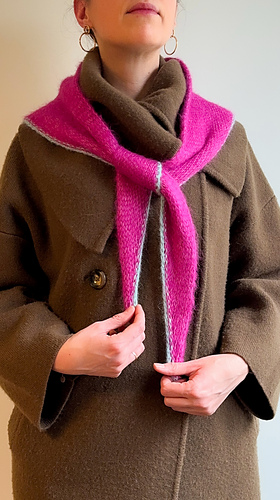
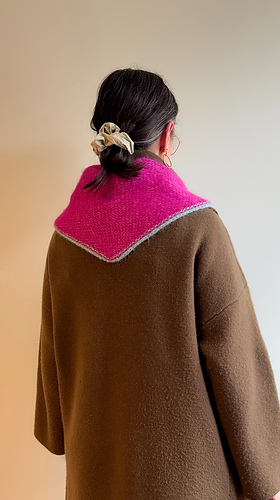
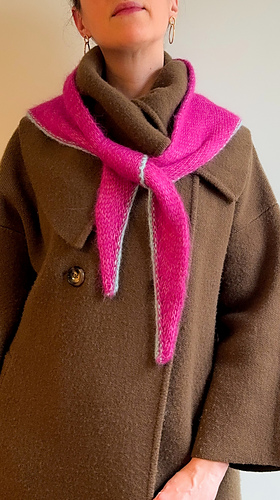
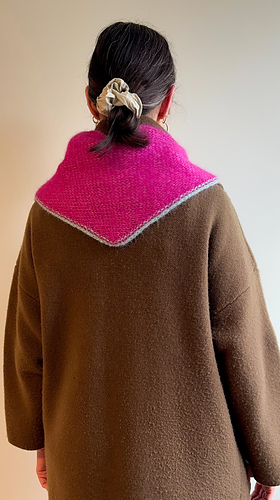
Amapola Shawl

---------------- DESCRIPCIÓN EN ESPAÑOL ABAJO ----------------
INTRO
This piece is knitted flat using tubular knitting, which makes both sides identical, creating a smooth stockinette fabric.
It is worked in one single piece, starting from one tip, increasing until reaching the center.
Then, decreases are made until reaching the opposite tip.
GAUGE
Knitted flat in double knitting (tubular knitting) with 4.50 mm / US 7 needles:
BEFORE blocking: 17 stitches x 19 rows = 10 x 10 cm 4 x 4″
AFTER blocking: 22 stitches x 15 rows = 10 x 10 cm 4 x 4″
After blocking, the gauge changes because the fabric needs to be stretched lengthwise, not widthwise, to achieve the longest possible shape for the shawl.
Since this is a shawl, it doesn’t matter if it turns out slightly larger or smaller, but keep in mind that gauge also affects the amount of yarn used.
MATERIALS
Yarn:
For the scarf shown in the photos, I used My Knitted Closet - The Finest Suri (53% Baby Suri Alpaca, 27% Recycled Silk, 20% Cotton) | 50 g, 125 meters 136 yards.
- 2 ball, shown in color Buganvilla.
- Approx. 230 meters 255 yards.
Optional, for the edging:
A small amount of any contrasting yarn. I used the same yarn, in color Ibiza.
Needles:
4.50 mm / US 7 circular needles with a 60 cm 24” cable or longer.
Extras:
Tapestry needle for weaving in ends, measuring tape or ruler, and scissors.
MEASUREMENTS
Width at the widest point: 26 cm 10”
Length from tip to tip: 150 cm 59”
The measurements are taken after washing and stretching the piece. You need to wash it before use, as it changes significantly before and after washing.
When drying it flat, stretch both tips where you started and finished knitting.
---------------- ESPAÑOL ----------------
INTRO
Está tejido en plano, en tejido doble, o tejido tubular (con puntos deslizados) con lo cual el derecho y el revés de la prenda se ve igual, en punto liso.
Se teje en plano de una sola pieza, comenzando en uno de los vértices, aumentando hasta llegar al centro.
Después se disminuye hasta llegar al otro vértice.
Opcionalmente puedes hacer el borde en contraste que ves en las fotos, también viene descrito en el patrón, se realiza levantando puntos y cerrándolos posteriormente con el cierre elástico Jeny’s Surprisingly Stretchy Bind-Off.
MUESTRA
Tejido en plano en tejido tubular con agujas de 4.50 mm / US 7, y
ANTES de bloquear:
17 puntos x 19 vueltas = 10 x 10 cm 4 x 4″
DESPUÉS de bloquear:
22 puntos x 15 vueltas = 10 x 10 cm 4 x 4″
Tras bloquear, la muestra cambia porque hay que estirar la muestra a lo largo, no a lo ancho, para que el chal quede lo más alargado posible.
Aunque es un chal y da igual si te queda un poco más grande o pequeña, ten en cuenta que la muestra también afecta a la cantidad de hilo usado.
MEDIDAS
Ancho (en el pico central): 26 cm 10”
Largo de vértice a vértice: 150 cm 59”
Las medidas son con la prenda ya lavada y estirada, tienes que lavarla antes de usarla, ya que cambia mucho antes y después del lavado.
Cuando la dejes secar, sobre una superficie plana, tienes que estirar de los dos vértices por los que has comenzado y acabado de tejer.
MATERIALES
Hilo:
Para el chal que se ve en las fotos, he usado My Knitted Closet - The Finest Suri: 53% Baby Suri Alpaca, 27% Seda reciclada, 20% algodón. | 50 gr, 125 metros 136 yardas.
-
2 ovillos, se muestra en el color Buganvilla.
-
Aproximadamente 230 metros 255 yardas.
-
Opcional, para el borde: Un resto de cualquier hilo que tengas, que haga contraste, yo he usado el mismo hilo, en color Ibiza.
Agujas:
Agujas circulares de 4.50mm / US 7 con cable de 60cm 24” o más largo.
Extras:
Aguja lanera para rematar cabos, metro o regla y tijeras.


 Ravelry download


 Cancel
69 projects
stashed 51 times
 stashed