

 Christal LK Designs
 Pattern


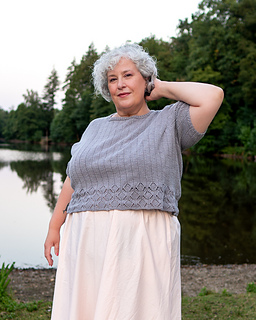
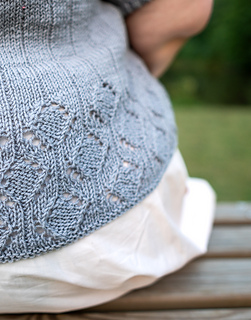
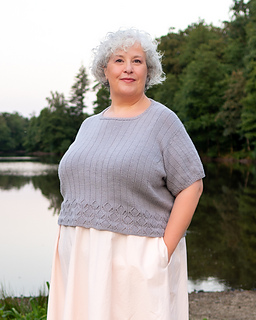
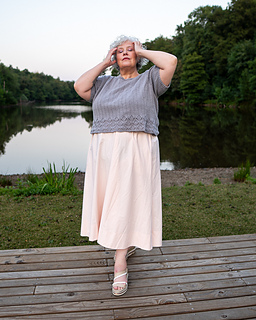
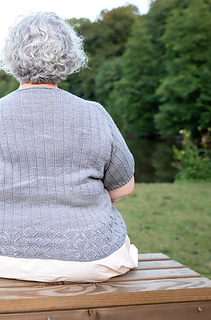
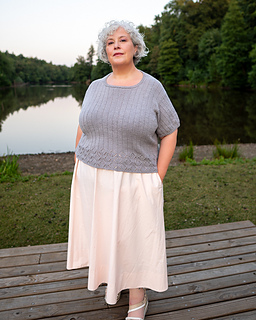
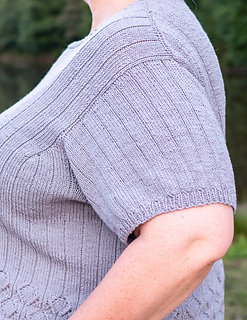
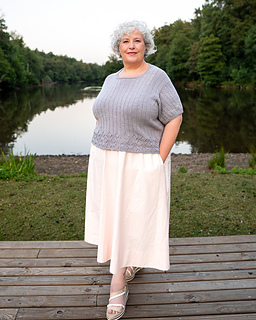
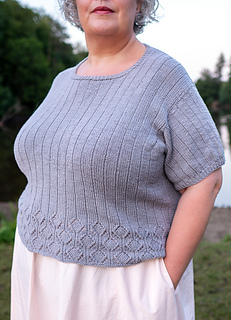
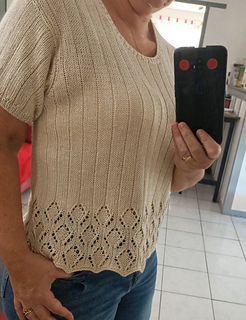
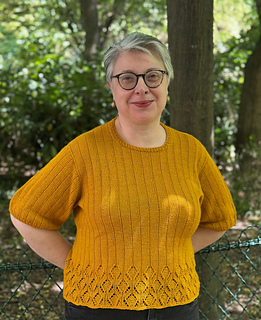
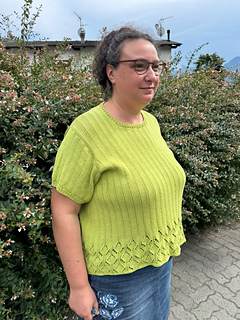
Limagne (Tee)

Shown in size 6 - 135 cm - positive ease 7 cm
This pattern is #sizeinclusive
Suggested yarn
CLK Peregrine (100% Est-A-Laine Merino) 388 m / 100 g approx. 860 (959, 1047)(1138, 1281)(1335, 1459, 1598) m or 3 (3, 3)(3, 4)(4, 4, 5) skeins color Perle
Notions
3.5 mm (US 4) 60 cm (32’’) circ needle for fronts and back
3.5 mm (US 4) 100 cm (40’’) circ needle for body
Set of 3.5 mm (US 4) or needles for your preferred method of small circumference knitting for sleeves
tapestry needle
4 Stitch markers if needed
4 Removable markers
Finished Chest Measurements
85 (95, 105)(115, 125)(135, 145, 157.5) cm
Construction
This tee is worked from the top .
First, the back is worked flat to the armholes.
Then you pick up stitches along the shoulders to work the fronts separately while creating the neckline.
Once the fronts are finished, join the back and fronts to form the body, which you work in the round.
The body is finished with a large lace panel.
The sleeves are then picked up along the front and back sides and worked with short rows to create the cap.
This sweater can be worn with a positive ease of 5 to 10 cm.
Skills level
3/5
Laine suggérée
CLK Peregrine (100% Est-A-Laine Mérinos) 388 m / 100 g environ 860 (959, 1047)(1138, 1281)(1335, 1459, 1598) m ou 3 (3, 3)(3, 4)(4, 4, 5) écheveaux coloris Perle
Matériel
1 aig. circ. 3,5 mm de 60 cm de long pour le dos et les devants
1 aig. circ. 3,5 mm de 100 cm de long pour le corps
5 aig. doubles pointes 3,5 mm pour les petites circonférences (manches) si néc.
1 aig. à tapisserie
4 marqueurs si néc.
4 marqueurs amovibles
Tailles
85 (95 ; 105)(115 ; 125)(135 ; 145 ; 157,5) cm
Construction
Ce top est tricoté de haut en bas
Tout d’abord, le dos est travaillé à plat jusqu’aux emmanchures.
Vous releverez ensuite les mailles le long des épaules pour travailler les devants séparément tout en créant l’encolure.
Une fois les devants terminés, vous joindrez dos et devants pour former le corps que vous tricoterez en rond.
Le corps se termine par une grande zone de dentelle.
Les manches sont ensuite relevées le long des côtés devants et dos et sont travaillées avec des rangs raccourcis pour former le dessus de l’épaule.
Ce pull se porte avec une aisance positive de 5 à 10 cm.
Niveau
3/5


 Ravelry download


 Cancel
214 projects
stashed 204 times
 stashed