

 Garcia.knits ravelry store
 Pattern


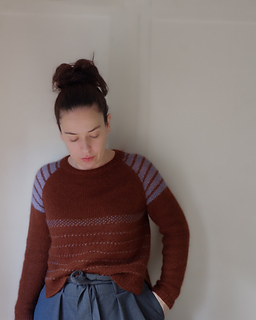
Theo Sweater

ENGLISH INFO:
This pattern was first published in March 2020. It has been revised, reworked, retested and improved.
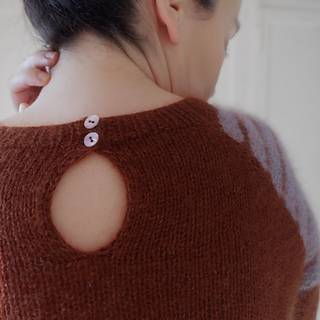
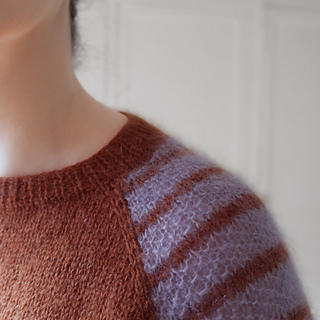
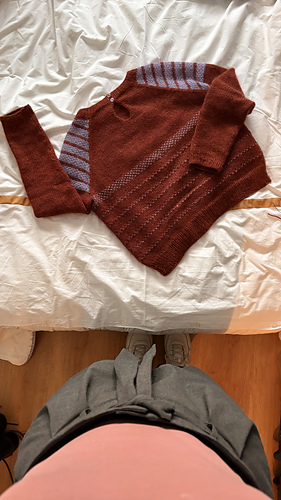
This sweater is worked 2 strands held together, top-down without seams. You’ll begin working flat with the MC for the neckline (it has an opening with two buttons at the back).
After working the ribbed band, we’ll place markers and begin working three things at once:
- Short rows to shape the back neckline.
- Increases on both sides of the markers: in some rows, you’ll work increases only on the front and back (indicated next to the row number in parentheses with lowercase inc), and in others, there will also be increases on the sleeves (indicated next to the row number in parentheses with uppercase inc).
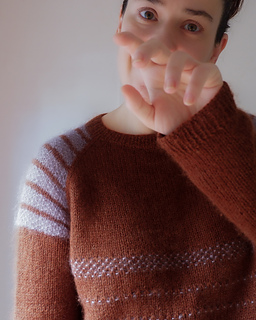
- Intarsia worked flat to work the CC stripes you see on the sleeves. For this, you’ll need 3 balls (Alpaca 2 + Silk Mohair) of MC and 2 balls (2 strands of Silk Mohair) of CC.
At a certain point on the yoke, we’ll join the backs and you’ll begin working intarsia in the round until you reach the depth of the yoke. For this, you’ll need 2 balls (2-weight alpaca yarn + 1-weight silk mohair) of MC and 2 balls (2-weight silk mohair) of CC.
Once you’ve reached the raglan depth, separate the body and sleeves and cast on some stitches under the arm. The suggested method for casting on under the arm is the twisted back loop, similar to the back loop but much more stable and elastic, designed to prevent looseness while still being easy to work with mohair. From here on, you’ll stop working intarsia and you won’t need more than one ball of each color. Work the body mostly with MC until you reach the indicated length; occasionally, you’ll need to work a round or two with CC to keep things interesting.
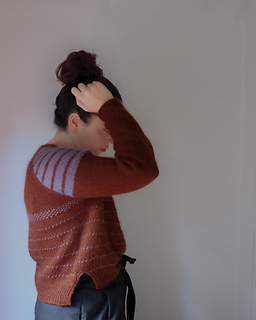
At the bottom edge, separate the front and back pieces to work each one flat. The front is slightly shorter than the back. Finish each piece with a 1x1 ribbing hem, a final row purled on the WR (so it’s slightly rolled up), and a Ruke bind-off, which creates lovely little knots and is very gentle on mohair.
To finish, pick up the stitches from the sleeves and work them first straight, then with decreases to reach the correct cuff size. For the cuff, work 1x1 ribbing again, a final knitted row and the same pretty Ruke bind-off.
This pattern comes with a file explaining how to make the following modifications, only if you feel them necessary: wider sleeves, intermediate sizes (24 sizes in total; to better fit your silouette) & short rows to fit the bust (with instructions for each cup and size, so that the drape is perfect).
SKILLS: Intermediate
SIZES: 1, 2, 3 (4, 5, 6) 7, 8, 9 {10, 11, 12}
Recommended ease: between 10 and 20 cm / 4 - 8” of positive ease at bust circumference.
In the photos I am wearing a size 4 with a positive ease of 16 cm / 6.25” at bust circumference.
BUST CIRCUMFERENCE:
81, 90.5, 100 (109.5, 119, 128.5) 137.5, 147, 156.5 {166, 175.5, 185} cm.
32, 35.75, 39.5 (43, 47, 51) 54, 58, 61.5 {65.5, 69, 72.75}“.
RECOMMENDED YARN:
MC: You will work two strands held together, one of alpaca + one of mohair.
Isager, Alpaca 2; fingering weight. 50% alpaca, 50% wool. 50 g, 250 m / 1.76 oz, 273 yd. #33.
+
Isager, Silk Mohair; lace weight. 75% superkid mohair, 25% silk. 25 g, 212 m / 0.88 oz, 232 yd. #33.
CC: You will work two strands of mohair held together.
Isager, Silk Mohair; lace weight. 75% superkid mohair, 25% silk. 25 g, 212 m / 0.88 oz, 232 yd. #12.
YARDAGE:
MC: Isager, Alpaca 2; fingering weight. 50% alpaca, 50% wool. 50 g, 250 m / 1.76 oz, 273 yd. #33.
103, 115, 127 (139, 151, 163) 175, 186, 198 {211, 223, 235} g.
515, 575, 635 (695, 755, 815) 875, 930, 990 {1055, 1115, 1175} m.
562, 628, 693 (759, 825, 890) 956, 1016, 1081 {1152, 1218, 1283} yds.
3, 3, 3 (3, 4, 4) 4, 4, 4 {5, 5, 5} skeins (50 g).
CP: Isager, Silk Mohair; lace weight. 75% superkid mohair, 25% seda. 25 g, 212 m / 0.88 oz, 232 yd. #33.
62, 70, 77 (84, 92, 99) 105, 113, 120 {127, 135, 142} g.
526, 594, 653 (712, 780, 840) 890, 958, 1017 {1077, 1145, 1204} m.
575, 650, 715 (780, 854, 919) 975, 1049, 1114 {1179, 1252, 1318} yds.
3, 3, 4 (4, 4, 4) 5, 5, 5 {6, 6, 6} balls (25 g).
CC: Isager, Silk Mohair; lace weight. 75% superkid mohair, 25% seda. 25 g, 212 m / 0.88 oz, 232 yd. #12.
14, 16, 17 (19, 21, 22) 24, 26, 27 {29, 30, 32} g.
119, 136, 144 (161, 178, 187) 204, 221, 229 {246, 254, 271} m.
130, 148, 158 (176, 195, 204) 223, 241, 251 {269, 278, 297} yds.
1, 1, 1 (1, 1, 1) 1, 2, 2 {2, 2, 2} ball/s (25 g).
Keep in mind that these yardage have an extra 5% just in case (because even if the gauge matches, it doesn’t have to be exactly the same).
INFO EN ESPAÑOL:
Este patrón se publicó por primera vez en Marzo del 2020. Ha sido reeditado, retejido, retesteado y mejorado
Este jersey se trabaja de arriba hacia abajo y sin costuras. Empezarás trabajando en plano y con el CP la parte del escote (tiene una abertura con dos botoncitos en la parte de la espalda).
Después de haber trabajado el elástico, pondremos Marcadores y vamos a empezar a trabajar tres cosas a la vez:
- Las vueltas cortas para dar forma al escote en la espalda.
- Aumentos a ambos lados de los marcadores: en algunas Filas trabajarás aumentos sólo en delantero y espaldas (se indica al lado del número de Fila entre paréntesis con aum en minúsculas) y en otras habrá aumentos también en las mangas (se indica al lado del número de Fila entre paréntesis con AUM en mayúsculas).
- Intarsia en plano para ir trabajando las franjas color contraste que ves en las mangas. Para trabajar esto necesi- tarás tener preparados 3 ovillos (hebra de alpaca2 + hebra de Silk Mohair) del CP y 2 ovillos (2 hebras de Silk Mohair) de CC.
En determinado punto del canesú, cerraremos la espalda y pasarás a trabajar intarsia en circular hasta completar la profundidad del canesú. Para trabajar esto necesitarás tener preparados 2 ovillos (hebra de alpaca 2 + hebra de Silk Mohair) del CP y 2 ovillos (2 hebras de Silk Mohair) de CC.
Una vez alcanzada la profundidad del raglán, separaremos cuerpo y mangas y montaremos puntos bajo el brazo. El método sugerido para montar puntos bajo el brazo es el de bucle hacia atrás retorcido, similar al de bucle hacia atrás pero mucho más estable y elástico, pensado para que no quede suelto pero sea sencillo trabajarlo con mohair.
A partir de aquí, dejamos de trabajar intarsia y ya no vas a necesitar más de un ovillo de cada uno de los colores.
Trabaja el cuerpo en su mayoría con CP hasta alcanzar el largo indicado, de vez en cuando te tocará hacer alguna vuelta con el CC para que “no te duermas”.
En el borde inferior se separan delantero y espalda para trabajar cada uno en plano, el delantero es algo más corto que la espalda. Rematarás cada uno con un elástico 1x1, una última Fila por el LR trabajando Revés hasta el final (para que quede un poquito enrollado) y un cierre de Ruke, que le hace unos piquitos estupendos y es muy “amable” para trabajar con el mohair.
Para terminar, recuperarás los puntos de las mangas y las trabajas primero rectas y luego con disminuciones para alcanzar la medida adecuada para el puño. En el puño, otra vez trabajaremos elástico 1x1, una última Vuelta trabajando Derecho hasta el final y el mismo cierre bonito de Ruke.
El patrón viene acompañado de un archivo en el que te explico como hacer las siguientes modificaciones, en caso de que las creas necesarias: tallas intermedias (22 tallas en total; para que se ajusten mejor a tu contorno) y vueltas cortas en el pecho (con instrucciones para cada copa y talla, para que la caída sea perfecta).
Nivel: Intermedio
TALLAS: 1, 2, 3 (4, 5, 6) 7, 8, 9 {10, 11, 12}
Holgura recomendada: entre 10 y 20 cm / 4 - 8” de holgura
positiva.
En la foto llevo una talla 4 con una holgura positiva de 16 cm / 6.25” en el contorno de pecho.
CONTORNO DE PECHO (PRENDA):
81, 90.5, 100 (109.5, 119, 128.5) 137.5, 147, 156.5 {166, 175.5, 185} cm.
32, 35.75, 39.5 (43, 47, 51) 54, 58, 61.5 {65.5, 69, 72.75}“.
HILO RECOMENDADO:
CP: Trabajarás con dos hebras a la vez, una de alpaca + una
de mohair.
Isager, Alpaca 2; grosor fingering. 50% alpaca, 50% lana. 50
g, 250 m / 1.76 oz, 273 yd. #33.
+
Isager, Silk Mohair; grosor lace. 75% mohair superkid, 25%
seda. 25 g, 212 m / 0.88 oz, 232 yd. #33.
CC: Trabajarás con dos hebras de mohair a la vez.
Isager, Silk Mohair; grosor lace. 75% mohair superkid, 25%
seda. 25 g, 212 m / 0.88 oz, 232 yd. #12.
CONSUMOS:
CP: Isager, Alpaca 2; grosor fingering. 50% alpaca, 50% lana. 50 g, 250 m / 1.76 oz, 273 yd. #33.
103, 115, 127 (139, 151, 163) 175, 186, 198 {211, 223, 235} g.
515, 575, 635 (695, 755, 815) 875, 930, 990 {1055, 1115, 1175} m.
562, 628, 693 (759, 825, 890) 956, 1016, 1081 {1152, 1218, 1283} yds.
3, 3, 3 (3, 4, 4) 4, 4, 4 {5, 5, 5} madejas (recuerda que son de 50 g).
CP: Isager, Silk Mohair; grosor lace. 75% mohair superkid, 25% seda. 25 g, 212 m / 0.88 oz, 232 yd. #33.
62, 70, 77 (84, 92, 99) 105, 113, 120 {127, 135, 142} g.
526, 594, 653 (712, 780, 840) 890, 958, 1017 {1077, 1145, 1204} m.
575, 650, 715 (780, 854, 919) 975, 1049, 1114 {1179, 1252, 1318} yds.
3, 3, 4 (4, 4, 4) 5, 5, 5 {6, 6, 6} ovillos (esta vez, son de 25 g).
CC: Isager, Silk Mohair; grosor lace. 75% mohair superkid, 25% seda. 25 g, 212 m / 0.88 oz, 232 yd. #12.
14, 16, 17 (19, 21, 22) 24, 26, 27 {29, 30, 32} g.
119, 136, 144 (161, 178, 187) 204, 221, 229 {246, 254, 271} m.
130, 148, 158 (176, 195, 204) 223, 241, 251 {269, 278, 297} yds.
1, 1, 1 (1, 1, 1) 1, 2, 2 {2, 2, 2} ovillo/s (esta vez, son de 25 g).
Estos consumos tienen un 5% más por si las moscas (porque aunque te coincida la tensión, no tiene porque ser exactamente
igual). Quizas en las tallas en las que se requieren solamente 3 gramos de la última madeja la realidad sea que no vas a necesitarla, tu decides si quieres vivir peligrosamente y arriesgarte a tener que trabajar un par de vueltas menos en el cuerpo.


 Ravelry download


 Cancel
12294 projects
stashed 9765 times
 stashed
26247 projects
stashed 11862 times