

 Laine Let's Crochet! Issue 2
 Pattern


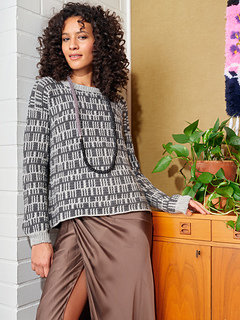
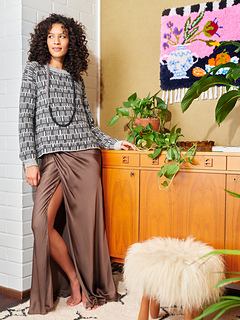
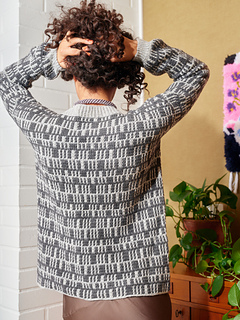
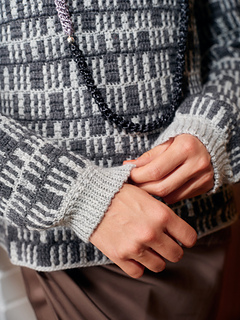
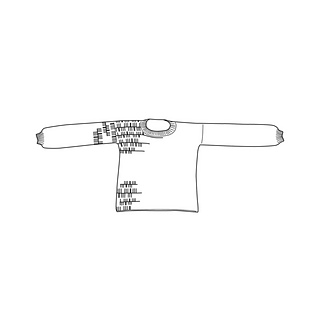
Urban Rhythm
Urban Rhythm is inspired by the colours, sounds and movement of the city. The design echoes the visual cadence of piano keys – creating a rhythmic interplay between light and dark that gives the piece its name.
SIZES
1 (2, 3, 4, 5) (6, 7, 8, 9, 10)
Recommended ease: 2.3–4” / 6–10 cm of positive ease.
FINISHED MEASUREMENTS
Chest Circumference: 31.5 (35.5, 39.5, 43.25, 47.25) (51.25, 55, 59, 63, 67)“ / 80 (90, 100, 110, 120) (130, 140, 150, 160, 170) cm.
Upper arm: 11.75 (11.75, 13.75, 13.75, 13.75) (15.75, 15.75, 17.75, 17.75, 19.75)” / 30 (30, 35, 35, 35) (40, 40, 45, 45, 50) cm.
Body Length (underarm to hem): 16.75 (16.75, 16.75, 19, 19) (19, 19, 19, 19, 19)“ / 42.5 (42.5, 42.5, 42.5, 48.5) (48.5, 48.5, 48.5, 48.5, 48.5) cm.
Total Length: 22.5 (22.5, 23.5, 26, 26) (27, 27, 28, 28, 29)” / 57.5 (57.5, 60, 66, 66) (68.5, 68.5, 71, 71, 73.5) cm.
Sleeve Length: 18 (18, 18, 20.5, 20.5) (20.5, 20.5, 20.5, 20.5, 20.5)“ / 46 (46, 46, 52, 52) (52, 52, 52, 52, 52) cm.
MATERIALS
Yarn: Laine x Novita 4ply by Novita (70% Falkland Wool, 15% Bluefaced Leicester, 15% Bluefaced Kerry Hill, 437 yds / 400 m – 100 g).
C1: 3 (3, 3, 3, 4) (4, 4, 4, 4, 5) skeins in the colourway Tender Fog.
C2: 3 (3, 3, 3, 3) (4, 4, 4, 4, 4) skeins in the colourway Soft Claystone.
Or approx. the following amounts of fingering-weight yarn:1311 (1311, 1311, 1311, 1748) (1748, 1748, 1748, 1748, 2185) yds / 1200 (1200, 1200, 1600, 1600) (1600, 1600, 1600, 1600, 2000) m in C1 and 1311 (1311, 1311, 1311, 1311) (1748, 1748, 1748, 1748, 1748) yds / 1200 (1200, 1200, 1200, 1600) (1600, 1600, 1600, 1600, 1600) m in C2.
Alternative yarn suggestions are for example Metropolis by Scheepjes and Bio Balance GOTS by BC Garn.
Hook: C-2 / 2.5 mm.
Notions: Stitch markers.
GAUGE
20 sts and 20 rows to 4” / 10 cm in mosaic patt according to chart, after blocking.
NOTES
The sweater is worked bottom up, first working the body in the round. Once the body is complete, it’s divided into two sections: front and back, which are worked flat (so you’ll need to cut the yarn at the end of each row and rejoin it at the start of the next one). Then, the pieces are joined at the shoulder area. The neckband and cuff are worked using the join-as-you-go method. Finally, the sleeves are worked seamlessly and in the round, directly from the armholes.


184 projects
stashed 179 times
 stashed