

 In a Panda's World Ravelry store
 Pattern


Brigandines


ENGLISH
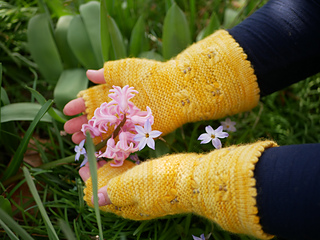
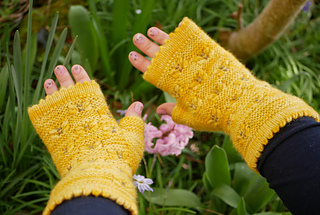
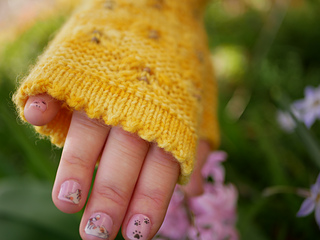
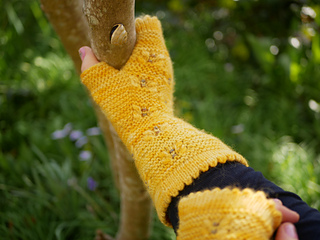
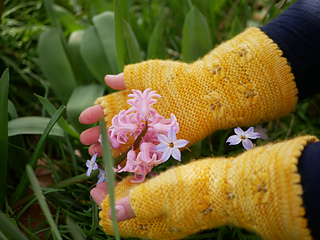
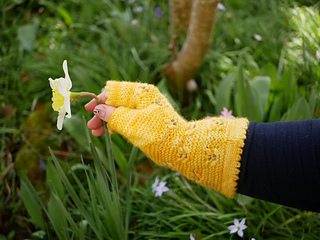
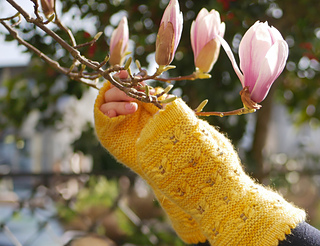
Looking for mitts that truly keep you warm? Choose the gauntlet shape. Inspired by medieval knights, they take their name from the brigandine, the riveted leather armor.
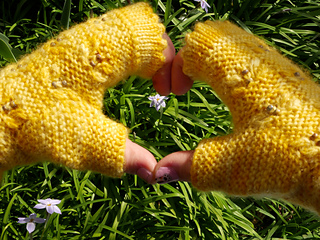
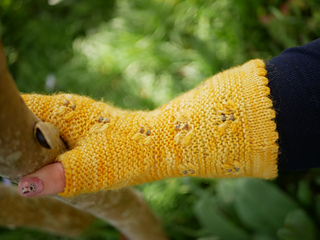
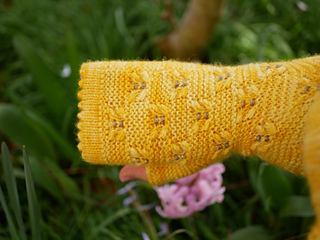
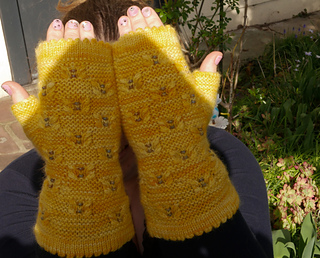
Brigandines Mitts are knit from the forearm to the fingers, entirely in the round. They are designed to be worn high, covering your sweater sleeves to create a genuine barrier against the cold. The finishes are delicate: picot hems at the forearm and fingers, and garter stitch for the thumb and palm. The motif on the back of the hand and the “gauntlet” section is worked fully in garter stitch, featuring a subtle interplay of increases, decreases, and crossed stitches, enhanced with beads for the final touch.
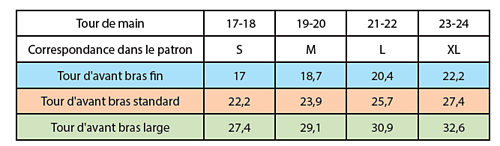
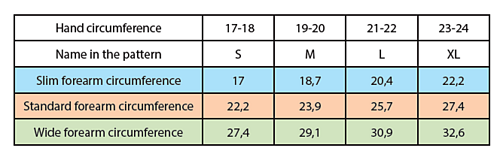
Three forearm widths are available for each size: slim, standard, and wide. A shorter version, beginning at the wrist, is also included.
Material
- Yarn: SPORT weight (non-SW) or DK (SW). I used an unknown yarn that appears to be a 100% wool SPORT weight (non-SW), approximately 300 m per 100 g.
130 to 200 m for the wrist version; 190 to 300 m for the forearm version. I used 212 m for size 19/20 (M), forearm version, wide fit. If substituting yarn, choose one with good loft. Avoid overly variegated colors, as they may obscure the motif.
• 3.5 mm circular needles (or size needed to obtain gauge).
• A second set of needles to close the picot hem at the forearm or wrist.
• A cable needle if needed.
• 3 to 9 stitch markers (depending on whether you knit them one at a time or both simultaneously).
• A tapestry needle to close the picot hem at the fingers.
• Miyuki 6/0 beads: 44 beads for the wrist version, 84 beads for the forearm version, for a total of 5 motif repeats.
• A crochet hook for the provisional cast-on.
Sizes
- Size is chosen based on the hand circumference measured at its widest point, typically just below the fingers, excluding the thumb, in centimeters. If you fall between sizes, choose the larger one. Negative ease is already built into the grading.
• Choose the forearm fit (slim, standard, wide) based on the measurement taken approximately 10 cm above your wrist. If you plan to wear them over sleeves, remember to account for your sweater. The stated measurement corresponds strictly to the measured circumference; no negative ease is included. You therefore have approximately 1.5 cm of stretch margin.
• For the wrist version, forearm circumference is irrelevant, as no adjustment is required.
Gauge
23 sts x 40 rows in garter stitch = 4 x 4 inches (10 x 10 cm), washed, blocked, and dry.
It is very important to meet both gauges if you want the correct size.
Extra
-> Each technique used in this pattern has a video link. Those videos are in French, but easily understandable just by watching.
-> Some abbreviations are colored inside the rows to make the reading easier.
-> Pattern is available as charts and row by row.
Skills
- work in the round
- garter stitch and stockinette stitch
- S1 wyib / S3 wyib
- M1R / M1L increases
- P2tog / SSK / K3tog / K3tog tbl decreases
- C1/2L - C2/1R
- provisional cast on
- grafting
Level of difficulty according to test-knitters : 2.2/5 (advanced beginner).
Average of time of test-knitters : 16 hours.
FRANCAIS
Vous cherchez des mitaines qui vous tiennent vraiment chaud ? Optez pour la forme gantelet ! Inspirées des chevaliers du Moyen-Âge, elles portent le nom de la brigandine, cette armure de cuir rivetée.
Les mitaines Brigandines se tricotent de l’avant-bras jusqu’aux doigts, entièrement en rond. Elles sont conçues pour être portées hautes, recouvrant les manches d’un pull pour créer une véritable barrière contre le froid. Les finitions sont délicates : dents de chat à l’avant-bras et aux doigts, et point mousse pour le pouce et la paume. Le motif du dessus de la main et de la partie « gantelet » est entièrement travaillé au point mousse, avec un subtil jeu d’augmentations, de diminutions et de mailles croisées, agrémenté de perles pour la touche finale.
Trois largeurs d’avant-bras sont disponibles par taille : fin, standard et large. Une version courte, qui commence au poignet, est également proposée.
Matériel :
• Fil : épaisseur SPORT non SW ou DK SW.
J’ai utilisé un fil inconnu qui semble être un fil sport 100% laine non SW, avec une équivalence de 300 m pour 100 g.
Comptez 130 à 200 m pour une version poignet ; 190 à 300 m pour une version avant bras. J’ai utilisé 212 m pour une taille 19/20, version avant-bras, ajustement large. Si vous souhaitez utiliser un autre fil, privilégiez un fil avec du gonflant. Évitez les couleurs trop bariolées au risque d’invisibiliser le motif.
• Aiguilles circulaires 3,5 mm (ou la taille nécessaire pour obtenir l’échantillon). Une seconde paire pour fermer le revers à dents de chat au niveau de l’avant-bras ou du poignet.
• Une aiguille à torsades si vous ne savez pas faire sans.
• 3 à 9 marqueurs (selon que vous les tricotiez une par une ou bien les deux en même temps).
• Une aiguille à laine pour fermer le revers à dents de chat au niveau des doigts.
• Des perles miyuki 6/0 : comptez 44 perles pour une version poignet, 84 perles pour une version avant-bras, pour 5 répétitions du motif en tout.
• Un crochet pour le montage provisoire.
Tailles :
-
La taille se choisit en fonction de la circonférence de la main au point le plus fort, généralement juste sous les doigts, sans le pouce, en centimètres. Si vous êtes entre deux tailles, choisissez la plus grande, l’aisance négative étant par défaut déjà incluse dans la gradation du modèle.
-
Choisissez l’ajustement avant bras (fin, standard, large) en fonction de la mesure que vous obtenez en mesurant votre avant bras à environ 10 cm de votre poignet. Pensez à prendre en compte votre pull si vous souhaitez les porter par-dessus. La mesure donnée est strictement celle obtenue, il n’y a pas d’aisance négative incluse. Vous avez donc une marge d’extensibilité d’environ 1,5 cm.
-
Si vous faites une version poignet, le tour d’avant bras n’a pas d’importance, vous ne ferez pas d’ajustement.
Échantillon
23 m x 40 rgs en point mousse, 10 x 10 cm, lavé, bloqué et sec.
Il est très important de respecter ces deux échantillons si vous voulez obtenir la bonne taille.
Bonus
-> Dans ce patron, toutes les techniques utilisées sont accompagnées d’une vidéo tutoriel.
-> Certaines abréviations sont colorées, notamment dans le rang par rang, pour faciliter la lecture.
-> Le motif est disponible en diagrammes et en rang par rang.
Techniques
- tricot en rond
- point mousse et jersey end.
- G1 fil derr. / G3 fil derr.
- augmentation intercalaire torse à droite et à gauche
- GGT, 2 m ens. env. / 3 m ens. env. / 3 m ens. env. BA
- C1/2G - C2/1D
- montage provisoire
- grafting
Niveau de difficulté selon les testeuses : 2.2/5 (débutant avancé).
Temps moyen de tricot des testeuses : 16 heures en tout.


 Ravelry download


 Cancel
49708 projects
stashed 29064 times
 stashed
6619 projects
stashed 4303 times
994 projects
stashed 500 times